Half marathon · Philadelphia, PA · November
Philadelphia Half Marathon course guide
A half from the Art Museum through Center City and the Fairmount Park hills, then down to the river to finish where it started.
- Distance
- 13.1 mi
- 21.1 km
- Net elevation
- +2 ft
- +1 m
- Total climb
- 252 ft
- 251 ft of descent
- Start → finish
- 32 → 34 ft
- above sea level
- Raced by Salitre
- 2015
Pace calculator
Your race plan, mile by mile
Set your goal and the calculator spreads it over the course: slower on the climbs, a little quicker on the descents, and the splits always add up to your goal.
Philadelphia Half Marathon: race plan
Your plan
- Goal time
- 1:45:00
- Flat-equivalent pace
- 7:58/mi
- Slowest split
- 8:17/mi
- Mile 8
- Predicted finish
- 1:45:00
Ideal strategy, uphill penalty 13 s/mi per 1%.
| Split | Elev ± | Effort | vs goal pace | Target pace /mi | Pace bank | Elapsed |
|---|---|---|---|---|---|---|
| Mile 1 | +9 ft | Flat | +0:06 | 8:07 | −0:06 | 8:07 |
| Mile 2 | −15 ft | Flat | +0:01 | 8:02 | −0:08 | 16:09 |
| Mile 3 | −9 ft | Flat | 0:00 | 8:01 | −0:08 | 24:10 |
| Mile 4 | +2 ft | Flat | −0:01 | 8:00 | −0:08 | 32:10 |
| Mile 5 | +9 ft | Flat | 0:00 | 8:01 | −0:08 | 40:11 |
| Mile 6 | +14 ft | Flat | −0:01 | 8:00 | −0:08 | 48:11 |
| Mile 7 | −23 ft | Flat | −0:05 | 7:56 | −0:03 | 56:07 |
| Mile 8 | +79 ft | Gentle climb | +0:16 | 8:17 | −0:19 | 1:04:24 |
| Mile 9 | −45 ft | Flat | −0:09 | 7:52 | −0:11 | 1:12:16 |
| Mile 10 | +57 ft | Gentle climb | +0:11 | 8:12 | −0:22 | 1:20:28 |
| Mile 11 | −88 ft | Gentle descent | −0:17 | 7:44 | −0:06 | 1:28:12 |
| Mile 12 | −6 ft | Flat | −0:06 | 7:55 | 0:00 | 1:36:07 |
| Mile 13 | +21 ft | Flat | 0:00 | 8:01 | −0:01 | 1:44:08 |
| Mile 13.1 | −4 ft | Flat | −0:05 | 7:55 | 0:00 | 1:45:00 |
Pace bank: seconds ahead (+) or behind (−) an even-pace schedule for the goal. vs goal pace: + is slower than the average goal pace. Plan from salitre.co/race-guides/philadelphia-half-marathon.
How the plan is worked out, and what the strategies mean: methodology.
The course
Course breakdown
Measured on Eduardo's own 2015 run of the course; elevation: Watch GPX (barometric altimeter); smoothed over 300 m, distance scaled to the official 13.1 mi.
Elevation at each mile marker
start: 32 ft · mile 1: 42 ft · mile 2: 27 ft · mile 3: 18 ft · mile 4: 20 ft · mile 5: 29 ft · mile 6: 43 ft · mile 7: 20 ft · mile 8: 99 ft · mile 9: 54 ft · mile 10: 111 ft · mile 11: 23 ft · mile 12: 17 ft · mile 13: 38 ft · finish: 34 ft
Miles 0–7 · 7.0 mi
Center City
- Climb
- 55 ft
- Descent
- 67 ft
- Net
- −12 ft
- average grade −0.0%
Flat city miles from the start on the Parkway.
Coach notes coming soon.
Miles 7–11 · 4.0 mi
Fairmount Park
- Climb
- 163 ft
- Descent
- 159 ft
- Net
- +3 ft
- average grade +0.0%
The course's climbs, in two clear rises.
Coach notes coming soon.
Miles 11–13.1 · 2.1 mi
Down to the finish
- Climb
- 35 ft
- Descent
- 24 ft
- Net
- +11 ft
- average grade +0.1%
Downhill to the river, then flat to the finish by the Art Museum.
Coach notes coming soon.
Race day
The coach's race-day strategy
Coach notes coming soon.
Logistics
Coach notes coming soon.
Questions
Philadelphia Half Marathon: common questions
How hilly is the Philadelphia Half Marathon?
Measured on the course, it climbs 252 ft and descends 251 ft, for a net change of +2 ft from start to finish. The most climbing per mile is between miles 7 and 11 (Fairmount Park), with 163 ft of climb.
How hilly is the second half of the Philadelphia Half?
Coach notes coming soon.
How should I fuel during the Philadelphia Half?
Coach notes coming soon.
Where should my supporters stand at the Philadelphia Half?
Coach notes coming soon.
Methodology
How the plan is worked out
The grade model
The course is cut into 50 m steps. On each, a climb steeper than +0.4% costs the uphill penalty you chose (12–15 seconds a mile for each 1% of grade); a descent steeper than −1% gives back 8 seconds a mile per 1%, up to 40 seconds a mile at −5%, where steeper ground stops paying back. In between, the pace is the flat pace.
The coefficients follow Jack Daniels' rule of thumb (Daniels' Running Formula, 3rd ed., 2014). Downhill giving back less than uphill costs, and the saving levelling off on steep descents, match the energy-cost measurements of Minetti et al. (Journal of Applied Physiology 93, 2002).
The flat pace is solved so the steps add up to your goal; split times are rounded to whole seconds and always add up to it exactly.
The strategies
- Ideal
- Even effort with a gentle negative split: effort 1% easier than average at the start, easing to 1% harder at the finish.
- Even effort
- The same effort throughout; only the hills move the pace.
- Conservative
- The first half 1.5% easier, the second half 1.5% harder: a negative split of about 3% on a flat course.
- Aggressive
- Even to slightly positive: 1% harder at the start, easing to 1% easier at the finish.
The columns
Pace bank is the cumulative number of seconds you are ahead (+) or behind (−) an even-pace schedule for your goal at the end of each split; it is spent on the climbs. Flat-equivalent pace is the pace the plan asks for on flat ground. The effort badge comes from the split's grade: Climb (+1.5% or more), Gentle climb (+0.4%), Rolling, Flat, Gentle descent (−1%), Steep descent (−2.5%).
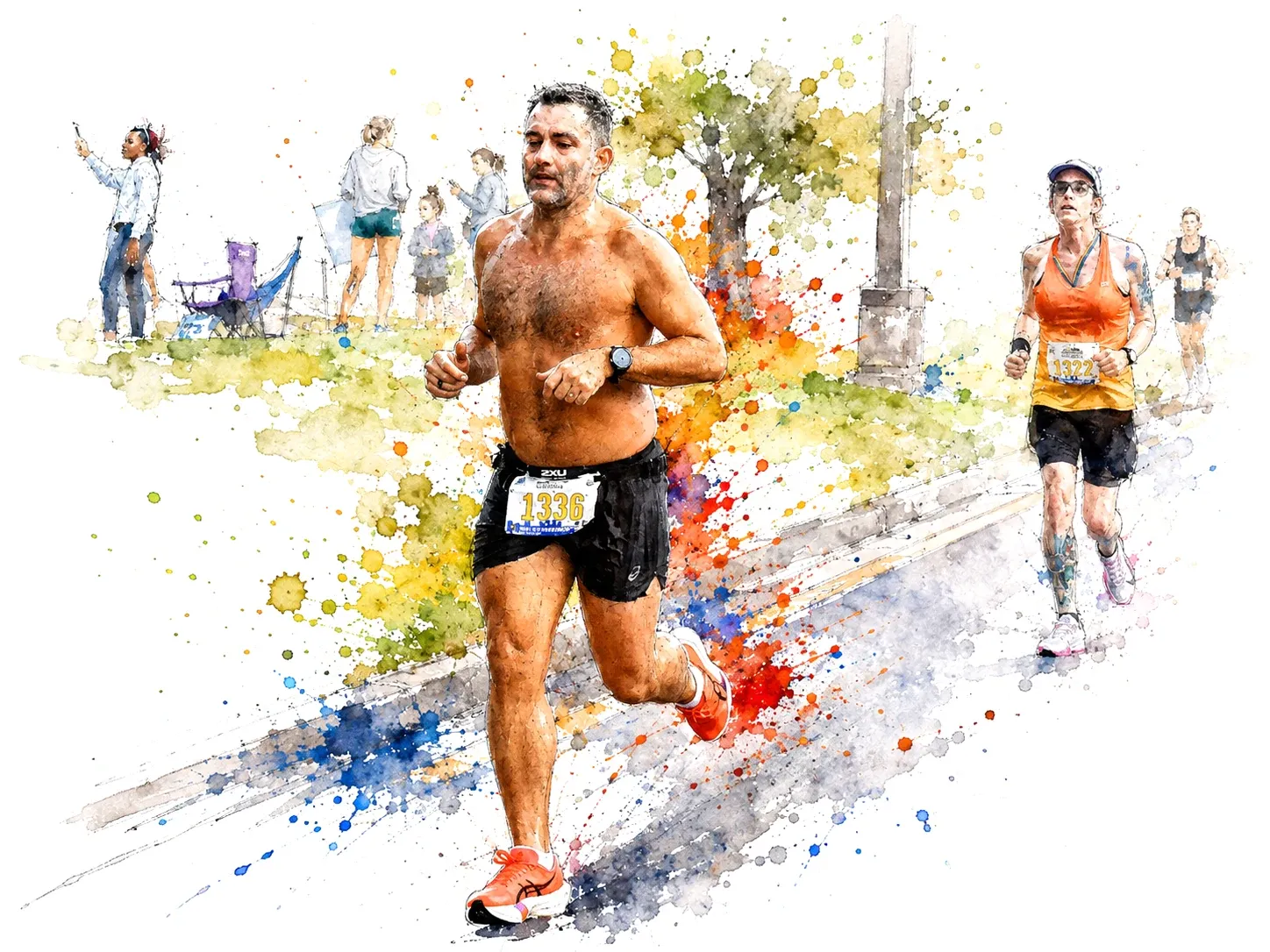
Philadelphia Half Marathon
Want a plan for this race?
Book a free 20-minute consult. Tell us your goal for this course and where your training is, and we'll see where a plan would start.
Book a free consult